

 Global
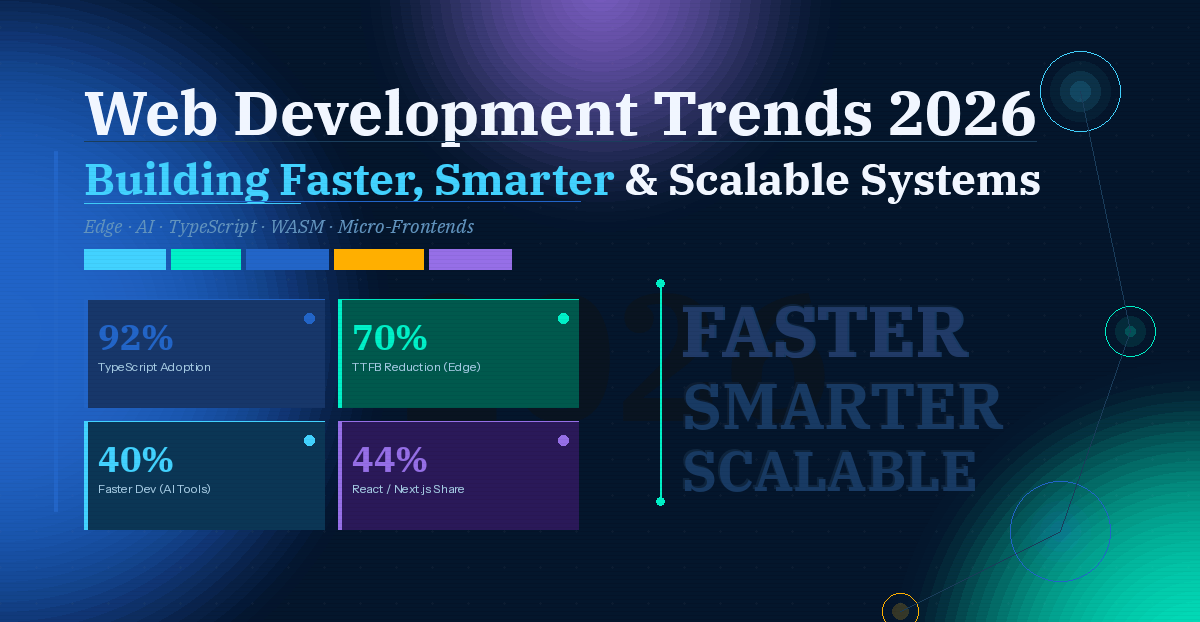
Web Development Trends 2026: Building Faster, Smarter & Scalable Systems
A deep technical look at the frameworks, architectures, and paradigms reshaping the web.
The web development landscape is evolving at an unprecedented pace. In 2026, the lines between frontend and backend continue to blur, AI is embedded directly into developer toolchains, and performance-first architectures have become the industry standard. At Iqra Tech Solutions Pvt Ltd, we stay ahead of these shifts so our clients always receive cutting-edge, future-proof solutions. Here is a technical breakdown of the trends every developer and tech leader must understand this year.
1. AI-Powered Development & Copilot Tooling
Artificial intelligence is no longer a feature you build — it is a tool you build with. In 2026, AI copilots have become integral to the developer workflow, accelerating productivity by automating boilerplate generation, intelligent code review, and real-time documentation.
Key Insight: Teams using AI-assisted IDEs report up to 40% faster feature delivery cycles.
-
GitHub Copilot X, Cursor, and Tabnine are now standard in professional environments
-
LLM-integrated CI/CD pipelines auto-detect bugs before code is merged
-
AI-driven testing frameworks generate test cases from function signatures automatically
-
Prompt-to-component tools like v0.dev allow rapid UI scaffolding from natural language
FIGURE 1 — AI Copilot Tool Adoption Among Developers

Fig. 1: Developer adoption rates of leading AI coding tools in 2026 (%)
2. Edge Computing & Edge-First Architectures
Edge computing has moved from experimental to essential. Rather than routing every request through a centralised origin server, edge-first architectures execute logic at CDN nodes geographically close to the end user — slashing latency and improving resilience.
Key Insight: Edge functions reduce Time to First Byte (TTFB) by up to 70% vs traditional deployments.
-
Platforms like Cloudflare Workers, Vercel Edge, and Deno Deploy are production-ready
-
Edge middleware handles auth, personalisation, and A/B testing without origin round-trips
-
Partial Prerendering (PPR) combines static shells with dynamic edge-streamed content
-
Edge databases such as Turso and D1 bring data closer to compute for ultra-low latency
FIGURE 2 — Performance: Edge-First vs Traditional Architecture
Fig. 2: Core performance metrics comparison — Edge-First vs Traditional Server (lower is better)
3. React Server Components & Full-Stack Frameworks
The server/client component model introduced by React 18+ has fundamentally changed how developers think about rendering. In 2026, this paradigm is fully mature and adopted across the ecosystem via Next.js 15, Remix, and SvelteKit.
Key Insight: Server Components eliminate unnecessary client-side JavaScript, improving Core Web Vitals significantly.
-
Server Components fetch data and render HTML on the server — zero JS sent to the client
-
Client Components are isolated to interactive islands, reducing bundle sizes
-
Streaming SSR enables progressive hydration for perceived performance gains
-
Turbopack (Rust-based bundler) replaces Webpack for near-instant HMR in development
FIGURE 3 — Frontend Framework Market Share 2026

Fig. 3: Global frontend framework market share distribution — 2026
4. TypeScript Dominance & Type-Safe Stacks
TypeScript adoption is no longer a preference — it is the industry default. In 2026, end-to-end type safety across the full stack using tools like tRPC, Zod, and Prisma has become standard practice for teams that value maintainability.
Key Insight: Type-safe APIs eliminate an entire class of runtime errors before deployment.
-
tRPC enables fully type-safe API contracts without REST or GraphQL schema overhead
-
Zod performs runtime schema validation aligned with TypeScript compile-time types
-
Prisma and Drizzle ORM provide type-safe database queries with auto-generated types
-
TypeScript 5.x introduces decorators, const type parameters, and variadic improvements
FIGURE 4 — TypeScript vs JavaScript Adoption (2020–2026)
Fig. 4: Year-over-year adoption trend — TypeScript continues to surpass plain JavaScript
5. Web Performance: Core Web Vitals 2026
Google’s Core Web Vitals remain a critical ranking factor and user experience benchmark. In 2026, Interaction to Next Paint (INP) has replaced FID, and performance budgets are enforced at the CI/CD pipeline level.
Key Insight: A 100ms improvement in page load time increases conversion rates by up to 8%.
-
INP (Interaction to Next Paint) measures responsiveness — target under 200ms
-
LCP (Largest Contentful Paint) optimised via fetchpriority and preload hints
-
CLS (Cumulative Layout Shift) controlled through skeleton screens and reserved aspect ratios
-
Automated Lighthouse CI and web-vitals.js enforce budgets in every pull request
FIGURE 5 — Core Web Vitals Score Comparison

Fig. 5: Radar comparison of Core Web Vitals scores — Edge-First App vs Average App (higher is better)
6. WebAssembly (WASM) Goes Mainstream
WebAssembly has crossed from niche to mainstream. In 2026, WASM powers computationally intensive browser applications — from image processing and video editing to in-browser machine learning inference — without any server round-trips.
Key Insight: WASM executes at near-native speed, enabling desktop-class applications in the browser.
-
Rust and C++ compiled to WASM power tools like Figma, Google Earth, and AutoCAD Web
-
WASI (WebAssembly System Interface) enables server-side WASM execution in Node and Deno
-
Component Model specification allows composable, language-agnostic WASM modules
-
PyScript and Blazor bring Python and C# directly to the browser via WASM runtime
7. Micro-Frontends & Module Federation
Large-scale web applications in 2026 are increasingly built as independently deployable micro-frontends. Webpack 5 Module Federation and its successors allow teams to ship frontend features autonomously without monolithic deployments.
Key Insight: Micro-frontends enable team autonomy at scale — each squad owns its domain end-to-end.
-
Module Federation 2.0 supports dynamic remote loading with improved type sharing
-
Each micro-frontend has its own CI/CD pipeline, technology stack, and release cadence
-
Native Federation (Angular) and vite-federation extend the pattern beyond webpack
-
Design system tokens ensure visual consistency across independently deployed modules
Conclusion
2026 is not a year of incremental updates — it is a year of architectural rethinking. From AI-augmented development to edge-first deployments and WASM-powered browsers, the web is becoming faster, smarter, and more capable than ever before. At Iqra Tech Solutions Pvt Ltd, we are actively integrating these technologies into our projects to ensure our clients remain competitive in an increasingly digital world. The future of the web is being written right now — and we are writing it.
"We are not just building websites anymore. We are engineering intelligent, edge-powered, type-safe digital experiences that perform at the speed of thought."
— Addy Osmani